

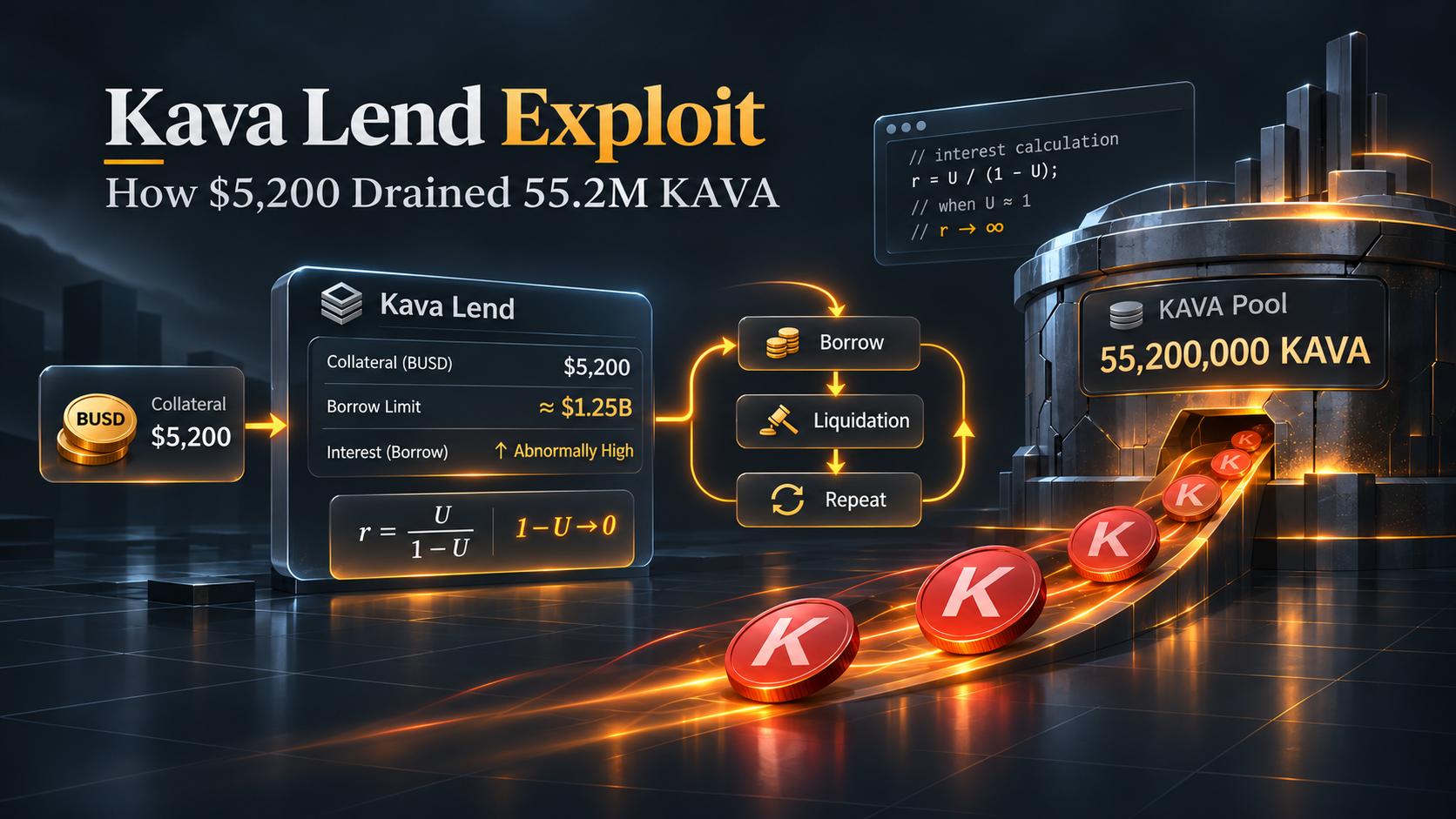
On November 14, 2026, the DeFi lending protocol Kava Lend (formerly HARD Protocol) suffered a major exploit. Within just 98 minutes—without manipulating price oracles or compromising private keys—the attacker used an initial capital of roughly $5,200 to drain 55,205,051 KAVA from the lending pool through 127 repeated cycles. Based on pre-attack market prices, the stolen assets were worth approximately $3.76 million.
Following the incident, the price of KAVA plummeted, hitting an all-time low.
The exploit stemmed from two critical flaws:
1. Stagnant Market & Interest Index Inflation: Prolonged inactivity in the BUSD market allowed the net supply used in interest calculations to be compressed to a minuscule value, causing the supply interest index to skyrocket.
2. Flawed Liquidation Logic: The liquidation function failed to verify the actual amount of collateral seized, wiping out the borrower's debt record even when zero valuable assets were recovered.
By exploiting the first flaw to fabricate massive on-paper collateral and the second to repeatedly borrow KAVA and clear the debt, the attacker systematically drained nearly the entire KAVA lending pool.
Cross-module interactions like this are a primary focus of BitsLab's security research, with its subsidiary ScaleBit dedicated to securing the EVM ecosystem, cross-chain bridges, and blockchain infrastructure. Below is a technical breakdown of the attack process, code vulnerabilities, and design flaws based on Kava Lend’s open-source codebase and on-chain transaction records.
1. Preparation: Anomalous State and Interest Calculation in the BUSD Market
1. Prolonged Illiquidity in the BUSD Market
The attacker targeted the BUSD lending market on Kava Lend. Paxos had ceased issuing new BUSD back in February 2023. Over time, the BUSD market on Kava lost activity and suffered from a prolonged lack of normal deposit and borrowing volume.
At 04:00 UTC on November 14, 2026, immediately before the attack, the market had approximately 440,145 BUSD owed to depositors, 5,084 BUSD in outstanding loans, and only 0.003 BUSD in available cash. Meanwhile, protocol reserves stood at 7,618 BUSD.
The protocol calculates net supply (totalSupply) using the following formula:
totalSupply = cash + borrows - reserves
Plugging in the pre-attack figures:
totalSupply = 0.003 + 5,084 - 7,618 = -2,533.997 BUSD
The market's net supply was already negative, with protocol reserves exceeding the sum of available cash and outstanding borrows. Because subsequent deposit interest calculations used totalSupply directly as the denominator, manipulating this denominator into a tiny positive integer would drastically skew the output.
2. Compressing Net Supply to 2 Base Units
Prior to the main attack, the attacker conducted cross-chain transfers and small deposit/withdrawal tests between November 6 and November 10.
At 04:00 UTC on November 14, the exploit began: First, the attacker used a primary wallet to pay off the entire 5,084 BUSD debt owed by the remaining 37 legacy borrowers, eliminating external variables from the upcoming calculations. Next, through a series of calculated deposits, borrows, and withdrawals, the attacker adjusted the pool's cash, borrows, and reserves until totalSupply was compressed to exactly 2 base units. Since BUSD on Kava uses 8 decimal places:
2 units = 0.00000002 BUSD
Simultaneously, the attacker retained a tiny outstanding borrow balance to bypass a specific check in the codebase: borrowedPrior.IsZero(). If prior borrows equal zero, the protocol skips interest accrual. Keeping a dust borrow ensured interest calculations would continue in subsequent blocks.
3. Supply Interest Index Jumps ~8,380x in a Single Block
At 04:01:18 UTC, interest accrual triggered on the next block, generating 16,759 base units of new interest (~0.00016759 BUSD).
With totalSupply compressed to 2 base units, the protocol computed the new SupplyInterestFactor:
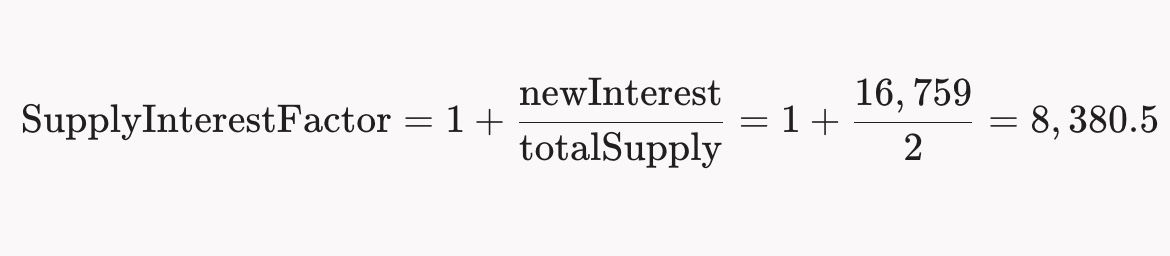
In a single block, the supply interest index jumped by roughly 8,380x.
Subsequent blocks continued compounding on this inflated base. By 04:03:58 UTC—just three minutes later—the supply interest index had surged from 2.76 to 671,187, a cumulative magnification of roughly 243,000x.
This distorted the attacker's on-paper balance: an initial deposit of ~$5,200 BUSD was inflated on the protocol's ledger into a claim worth approximately 1.26 billion BUSD. While no actual BUSD was minted, the protocol's collateral valuation and borrowing engines relied directly on these inflated accounting figures.
The attacker then repaid their dust borrow and used the inflated balance to withdraw the protocol's 7,618 BUSD in reserves. At this stage, the attacker had already recouped their ~$5,200 principal, pocketed ~$2,400 in profit, and retained ~1.26 billion BUSD in phantom collateral.
2. Borrow-and-Liquidate Loop: Draining the KAVA Pool
Kava Lend enforced a per-borrow cap on the KAVA market, limiting each borrow transaction to approximately 448,358 KAVA on the day of the attack. While intended to mitigate single-transaction risk, the attacker realized that clearing the debt via liquidation immediately freed up the borrowing limit for the next cycle.
Coordinating between a Main Wallet and a Helper Wallet, the attacker executed a repeating loop:
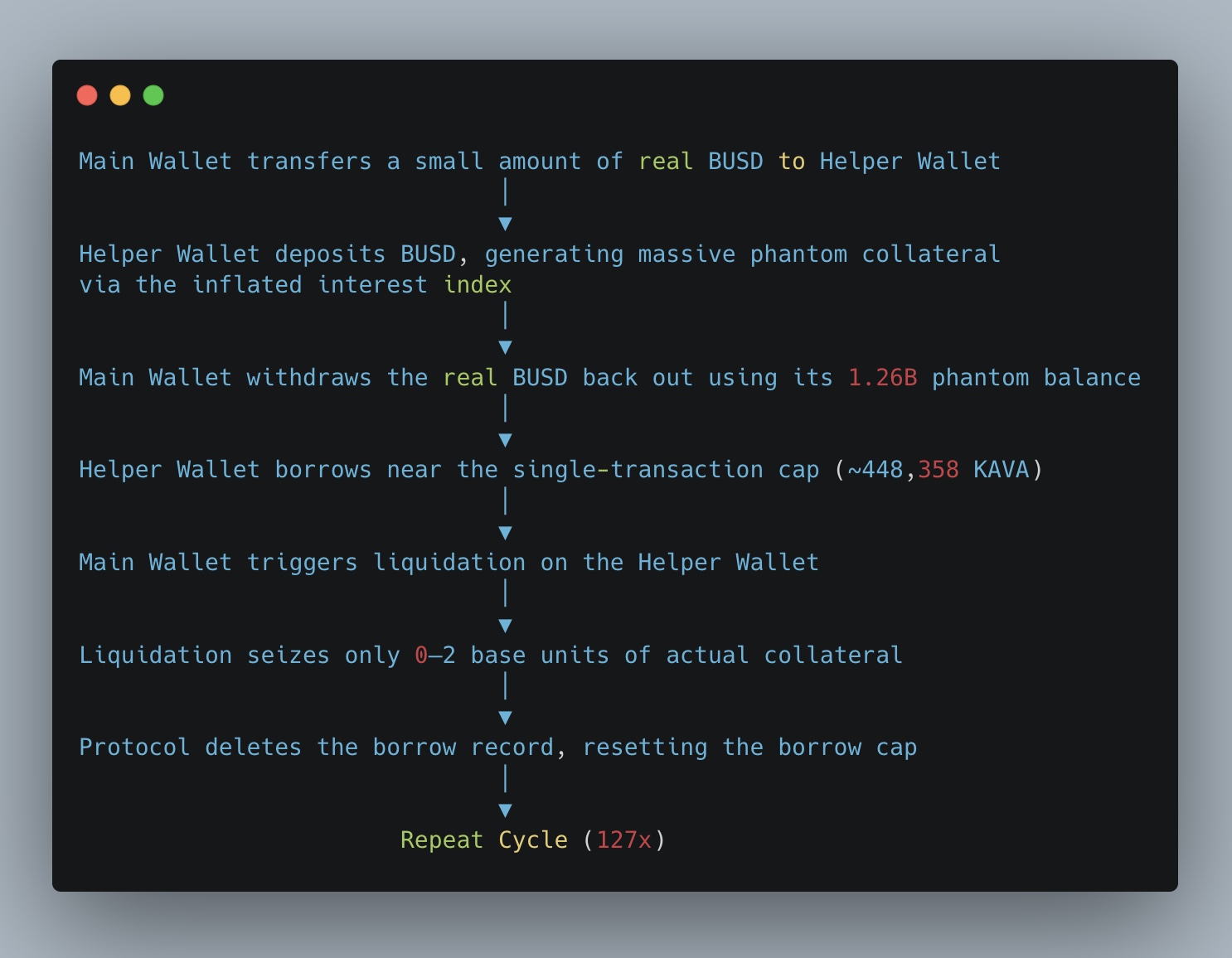
Between 04:04 and 05:42 UTC (roughly 98 minutes), the attacker executed this cycle 127 times. Out of roughly 55.33 million KAVA originally in the pool, only ~519 KAVA remained (some RPC nodes reported as little as 0.19 KAVA depending on query parameters). (Note: While Kava’s block time is ~6 seconds, each full attack cycle spanned multiple blocks to trigger liquidation and reset state.)
3. Source Code Analysis: The Two Root Vulnerabilities
Reviewing the x/hard module in the Kava-Labs/kava repository reveals two distinct code defects in the interest calculation and liquidation modules.
1. Missing Lower-Bound Check on the Interest Denominator
Located in x/hard/keeper/interest.go:
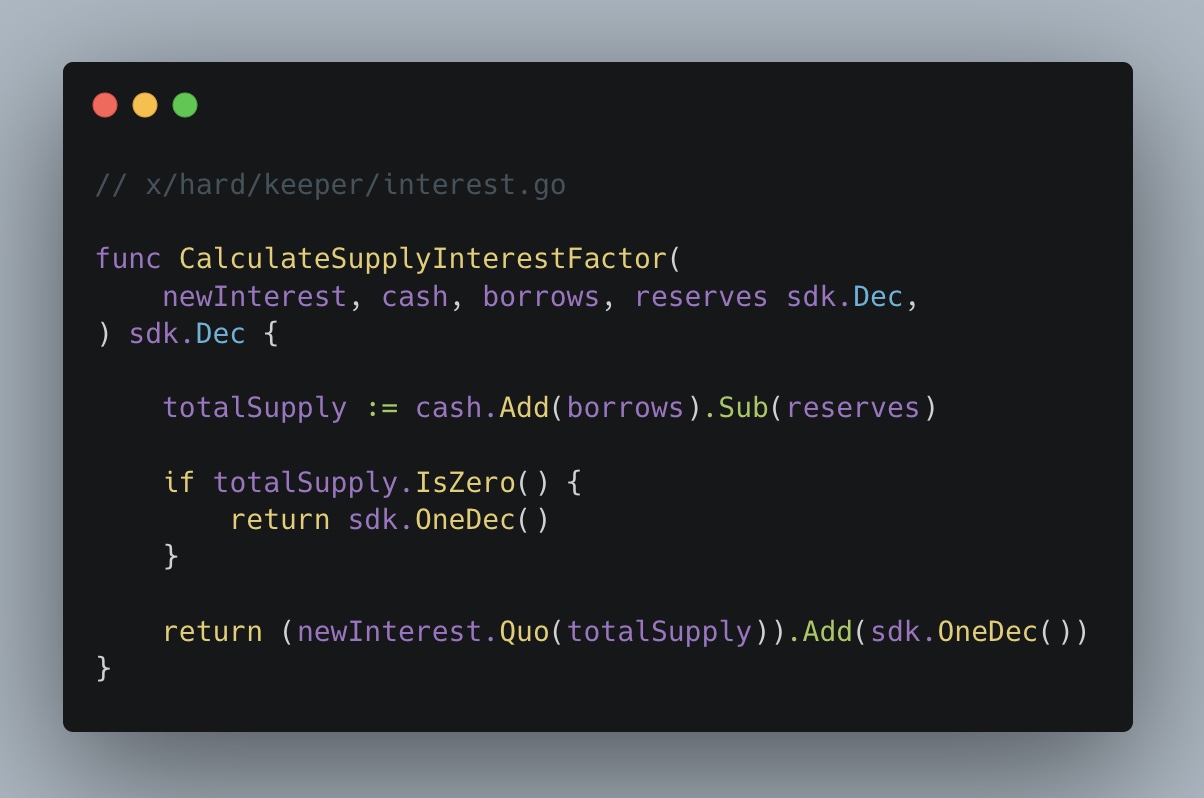
The developers only checked if totalSupply was strictly equal to zero (totalSupply.IsZero()), failing to guard against negative values or near-zero denominators. Under normal liquidity conditions, totalSupply stays large enough to prevent anomalies. Here, compressing the denominator to 2 base units caused minor interest accrual to explode into an astronomical multiplier.
Notably, CalculateUtilizationRatio in the exact same file explicitly checks for totalSupply. IsNegative(), highlighting inconsistent edge-case handling across the codebase. The protocol lacked both a minimum floor for totalSupply and a circuit breaker to cap abnormal index spikes.
2. Liquidation Wipes Debt Without Verifying Seized Collateral
Located in x/hard/keeper/liquidation.go within AttemptKeeperLiquidation:
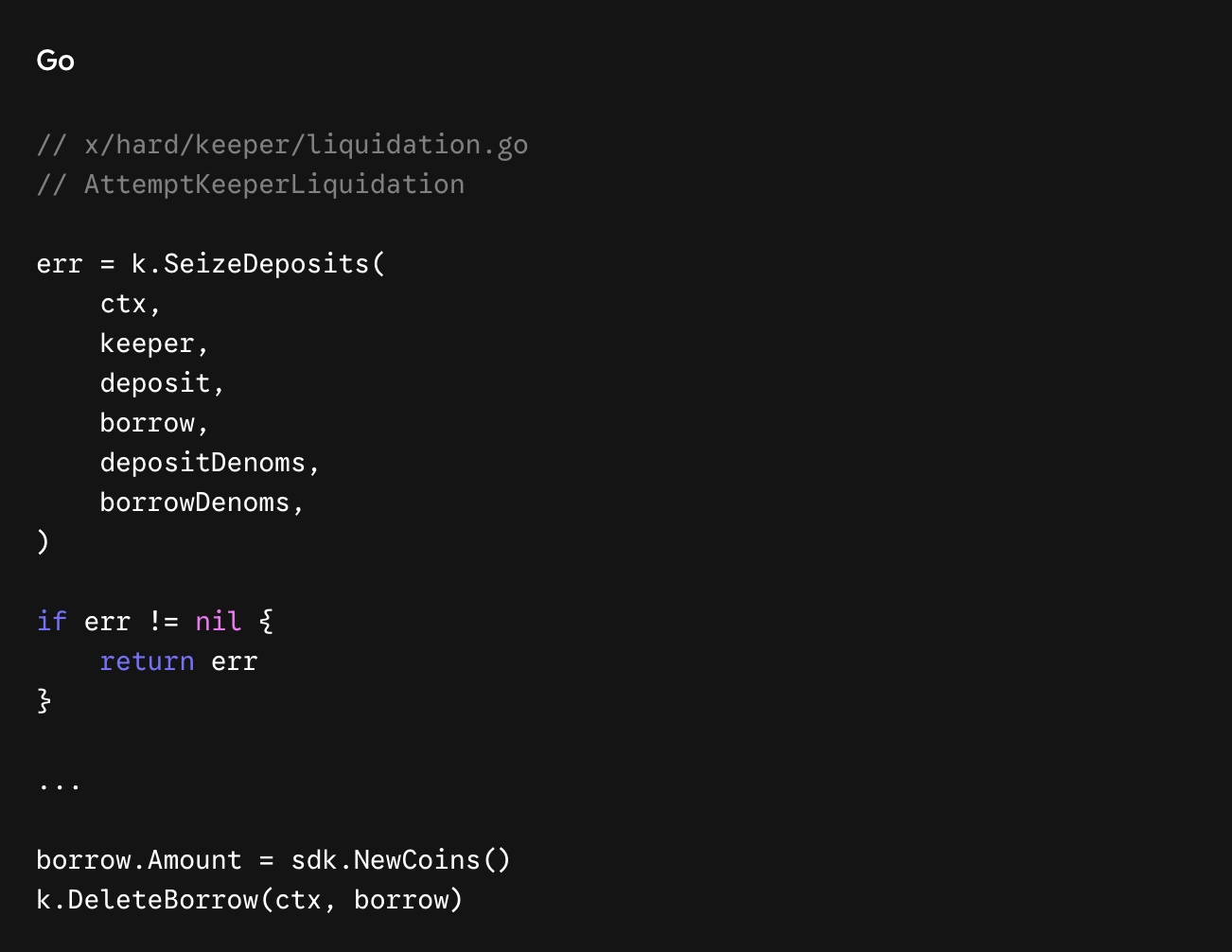
The execution order is fatal: as long as SeizeDeposits does not return an error, the function proceeds to zero out borrow.Amount and call k.DeleteBorrow.
Looking inside SeizeDeposits:
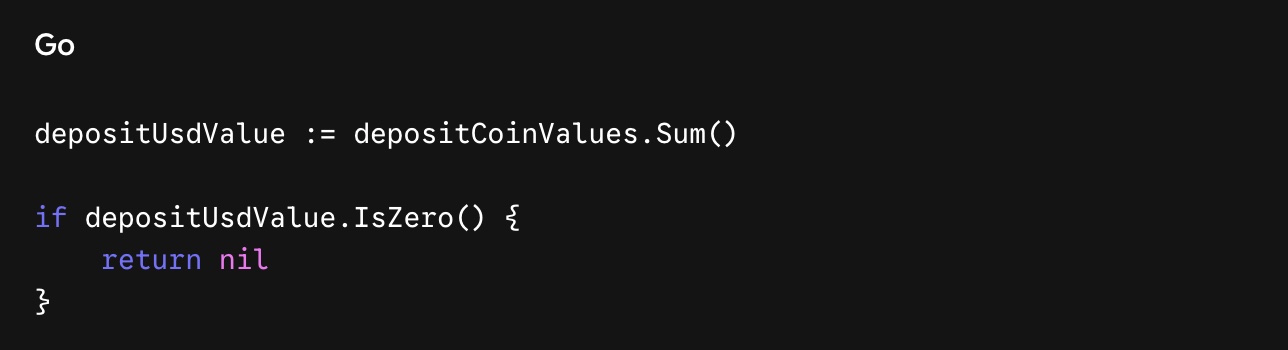
When the collateral's actual USD value is zero, SeizeDeposits exits early and returns nil. Because Go treats nil as a successful execution without errors, AttemptKeeperLiquidation assumes the collateral was seized and deletes the debt record anyway.
3. Combined Impact
Together, these two bugs formed a complete exploit chain: the missing denominator floor allowed the interest index to inflate by 243,000x, creating massive phantom collateral; the faulty liquidation check then allowed the attacker to clear their debt for free after every borrow, bypassing per-transaction caps until the pool was empty.
4. Fund Flows: Laundering and Cash-Out
Following the exploit, the attacker moved the stolen KAVA across chains and exchanges:
1. ~49.2 Million KAVA Bridged to BNB Chain
At 10:01 UTC, the attacker bridged ~49.2 million KAVA to BNB Chain via LayerZero (including a single transfer of ~48.2 million KAVA). Between 10:07 and 10:42 UTC, the attacker dumped ~48.4 million KAVA across 46 transactions—roughly 41.6 million via MetaMask Swaps and ~5.5 million via CoW Protocol. This massive sell pressure exhausted on-chain liquidity, crashing KAVA's price by ~36% and netting the attacker ~3,333 BNB and a small amount of USDT (worth ~$2.09 million total).
The proceeds were split into four paths:
- Path 1 (1,000 BNB): Swapped viaLI.FI and Relay into 612,416 USDT. Relay intercepted and froze these funds under a BLOCKED_WALLET flag, locking up ~29% of the attacker's realized proceeds.
- Path 2 (750 BNB): Converted to 450,776 USDC, bridged to Arbitrum, and deposited into Hyperliquid. Combined with other funds (~$1.17 million across 8 accounts), the attacker bought 2,190 XMR within one minute, where the funds currently sit idle.
- Path 3 (1,083 BNB): Swapped for 347 ETH, split across multiple fresh wallets, converted to USDC via LI.FI, and routed to Arbitrum.
- Path 4 (500 BNB): Swapped for 4,025 SOL, converted to 303,426 USDC, and sent to a high-frequency mixer/router wallet on Solana with over 100,000 monthly active addresses, obscuring the trail.
2. ~4.4 Million KAVA Sent to Instant Swaps & CEXs
Between 06:10 and 10:06 UTC—prior to the BNB Chain dump—the attacker sent ~4.4 million KAVA to instant-exchange deposit addresses. On-chain tracing shows return funds originating directly from HitBTC and Bybit hot wallets (e.g., 663,900 KAVA swapped for ~44,219 USDT). Because instant swaps and centralized exchanges maintain deposit logs, order histories, and KYC/withdrawal records, these transactions offer strong leads for law enforcement.
3. ~300,000 KAVA Remaining on Kava
Roughly 300,000 KAVA remains split across two associated addresses on the Kava mainnet. With major exchange partners suspending KAVA deposits and withdrawals, moving or liquidating these remaining tokens is heavily restricted.
5. Loss Assessment: Protocol Loss vs. Realized Proceeds vs. Market Cap
Public reports have cited varying loss figures. It is important to distinguish between three separate metrics:
1. Direct Protocol Loss (~$3.76 Million): At the pre-attack price of ~$0.068, the 55,205,051 drained KAVA were worth ~$3.76 million. With only ~519 KAVA left in the pool, suppliers face a recovery rate of roughly 0.001%.
2. Attacker's Realized Proceeds (~$1.45 Million): Severe slippage during the BNB Chain sell-off reduced the sale value of the 48.4 million KAVA to ~$2.09 million. Subtracting the ~$612,000 frozen by Relay leaves the attacker with roughly $1.45 million in accessible funds (before gas and bridging fees).
3. Market Cap Wipeout (~$37.70 Million): Panic selling drove KAVA down 49.2% over 7 days to an all-time low of $0.03195, erasing ~$37.70 million in secondary market capitalization (from ~$73.63M to ~$35.92M).
6. Official Response and Unresolved Risks
Following the exploit, Kava emphasized on social media that KAVA did not suffer infinite minting and that the incident was isolated to Kava Lend without affecting the Kava Layer-1 blockchain. While total KAVA supply remains intact at ~1.083 billion and chain consensus was unaffected, users still suffered real asset losses.
Two pressing issues remain unresolved:
- Insolvency & Compensation: Kava Lend’s governance token, HARD, has a total market cap of roughly $62,000—a fraction of the $3.76 million loss. Even minting or selling HARD cannot cover user losses. As of November 16, the team has neither released a full post-mortem nor announced a user reimbursement plan.
- Lingering 1.26 Billion Phantom BUSD Balance: On-chain state confirms the attacker's main wallet still holds the ~1.26 billion BUSD phantom deposit claim. Unless governance completely freezes or zeroes out these market parameters, any real BUSD deposited into the pool in the future could be immediately drained by the attacker.
7. Security Takeaways for DeFi Protocol Design
The Kava Lend exploit demonstrates how attackers can chain internal accounting flaws together without relying on flash loans or oracle manipulation:
- Guard Against Edge-Case Denominators: Interest rate models relying on utilization, supply, or borrow ratios must never assume normal market liquidity. Protocols must enforce minimum denominator floors, handle negative values consistently across all functions, and implement circuit breakers to block abnormal index spikes.
- Verify Actual Asset Transfers in Liquidations: A liquidation routine should never treat a non-error return (nil) as proof of collateral recovery. Protocols must verify the actual value of seized collateral against the debt cleared and route shortfalls through an explicit bad-debt accounting mechanism.
- Test Extreme and Stagnant Market States: Test suites must go beyond happy-path deposits, borrows, and liquidations. Teams should simulate dormant markets where reserves exceed cash plus borrows, net supply approaches zero or turns negative, interest indices spike exponentially, and on-paper collateral holds zero real-world liquidity.
For teams building DeFi lending protocols, EVM applications, or cross-chain infrastructure, catching cross-module vulnerabilities before deployment is critical. BitsLab provides comprehensive smart contract auditing, penetration testing, formal verification, and AI-driven risk detection, while ScaleBit specializes in security assessments for complex on-chain asset flows and cross-protocol interactions.